Surface-water monitoring for stations, buoys and field networks
Build the measurement point around representativeness, power, communications, biofouling, service access and the environmental decision the data must support.
The system in one paragraph
A surface-water system is more than a group of sensors. Select the representative depth and location, parameters, range, power budget, telemetry, enclosure or buoy, anti-fouling plan, service interval and data path as one architecture. Fixed stations, compact buoys and portable verification instruments solve different operational problems.
Inputs required before model selection.
Water body
River, lake, reservoir, groundwater, drainage channel or coastal water
Deployment
Fixed station, compact buoy, larger buoy, handheld survey or integrated cabinet
Common parameters
pH, conductivity, DO, turbidity, temperature, algae, chlorophyll and optional UV254 or ammonia
Field constraints
Depth, power, telemetry, vandalism, biofouling, weather and maintenance access
Connect each point to an operating decision.
Design the measurement, installation and data path together.
Fixed station
Useful where stable infrastructure, sample conditioning, multiple analyzers or regular site access are available.
Compact buoy
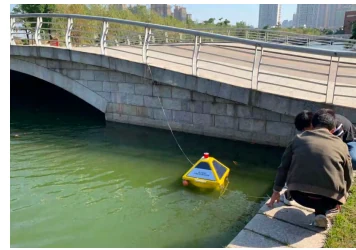
Useful for flexible lake, reservoir, pond and aquaculture deployment with a limited, clearly defined sensor package.
Larger integrated buoy
Useful when more sensors, solar power, warning lights, telemetry or longer deployment requirements justify the platform.
Portable verification
Useful for commissioning, transects and comparison at several depths or locations; it does not replace a fixed continuous point.
Compare technical pages after the duty is defined.
Mini Water Quality Monitoring Buoy
Compact buoy for a defined sensor set and low-power environmental monitoring.
View technical data ↗Small Water Quality Monitoring Buoy
Larger configurable buoy platform with documented solar and multiparameter options.
View technical data ↗Integrated Multiparameter Analyzer
Portable or deployable integrated probe for up to eight documented measurement channels.
View technical data ↗Online Chlorophyll-a Analyzer
Reagent-free fluorescence measurement for continuous chlorophyll-a monitoring.
View technical data ↗Online Blue-Green Algae Analyzer
Pigment-fluorescence measurement for continuous blue-green algae monitoring.
View technical data ↗Continue with selection guides and real project records.
Technical specifications come from model pages. Engineering context comes from focused guides. Project claims come only from the published case records linked here.
Selection guides
Multiparameter system selectionDefine parameters, sensor compatibility, data, power, installation and commissioning.↗UV254 COD analyzer selectionUse UV absorbance only after confirming optical path, water matrix, cleaning and correlation.↗Real project records
Integrated buoy monitoring projectsReal campus-lake, pharmaceutical-park and unmanned-boat monitoring records.↗MP301 groundwater projectsField deployment records for integrated multiparameter groundwater monitoring.↗UV254 COD environmental projectsRiver, lake and mobile monitoring examples with public English descriptions.↗Questions to resolve before quotation.
How do I choose between a fixed station and a buoy?+
Choose from the water-body location, required sensors, power, telemetry, weather, vandalism risk, service access and deployment duration. A fixed station supports more infrastructure; a buoy can reach representative open-water points.
How many parameters should a surface-water station measure?+
Use the smallest set that answers the monitoring objective. pH, conductivity, DO, turbidity and temperature are common, while algae, chlorophyll, UV254, ammonia or ions should be added only when justified by the program.
What information is needed for a buoy quotation?+
Provide water body, depth, current or wave conditions, deployment duration, parameters and ranges, data interval, telemetry, power, anchoring, warning-light needs, maintenance access, quantity and destination.