Pigment-fluorescence measurement for continuous blue-green algae monitoring
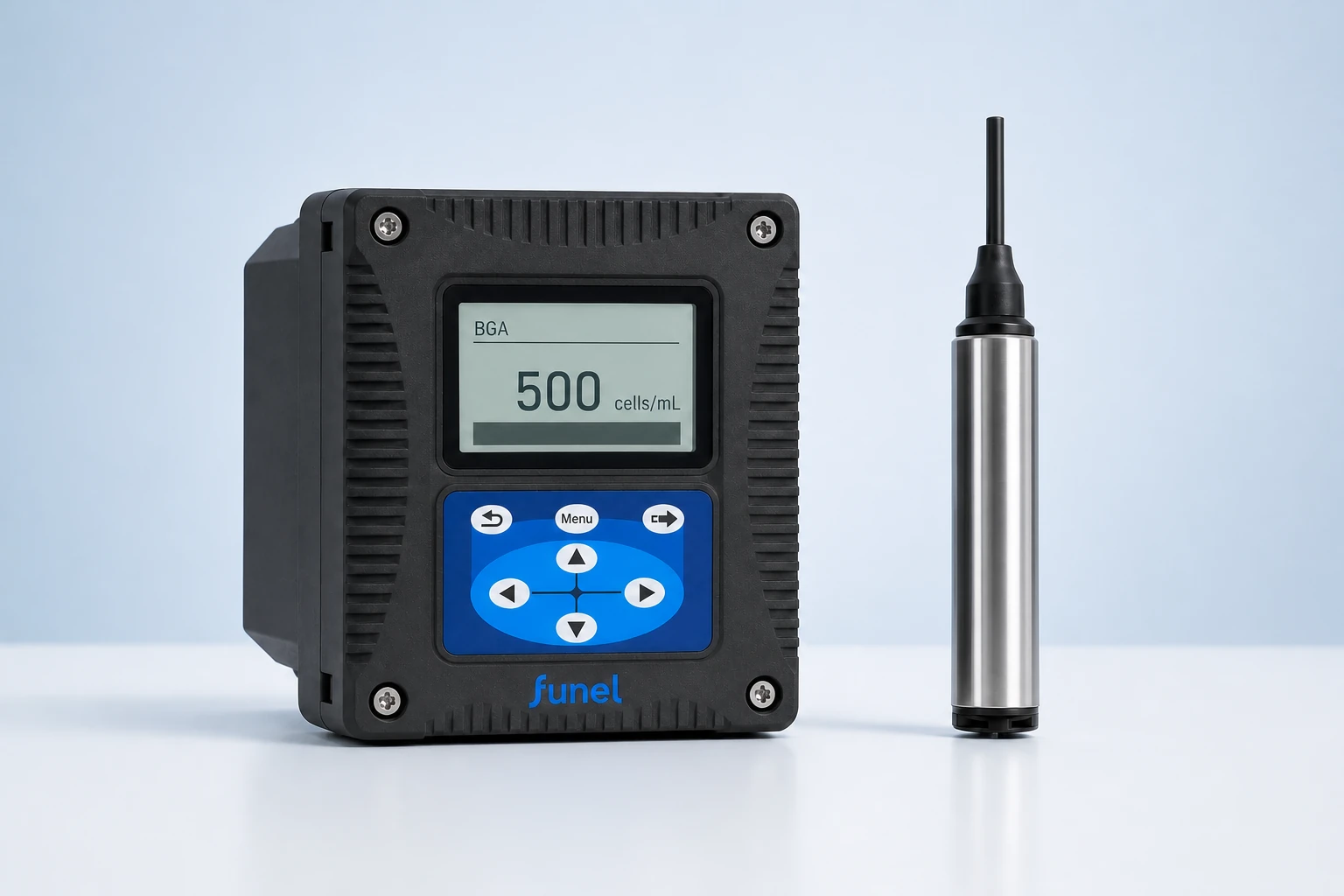
Fluorescence blue-green algae analyzer · PBA-800A
Online Blue-Green Algae Analyzer
A reagent-free fluorescence sensor for continuous blue-green algae measurement. Selection must consider uneven algae distribution, multipoint monitoring and the documented turbidity condition below 50 NTU.
0–300,000 cells/mL200 cells/mLTurbidity <50 NTU
Values checked item by item against the PBA-800A source
Range, detection limit, accuracy wording, turbidity condition, construction, dimensions and interfaces are stored separately. The black transmitter image is the approved FUNEL export presentation; final configuration remains subject to project confirmation.
01
Measurement principle and product highlights
Supports earlier identification of potential bloom conditions through pigment response
No reagent or sample pretreatment is required for rapid continuous measurement
Digital sensor output supports long-distance transmission and project integration
Plug-and-play field installation with reverse-polarity protection for sensor power and RS485 wiring
Three 4–20 mA outputs, three configurable relays, Modbus RS485 and optional wireless transmission
02
Product technical specifications
Before quotation, provide the monitoring objective, water matrix, expected cell concentration, normal and peak turbidity, number and distribution of monitoring points, pressure, mounting, cable, power, outputs and destination.
- Measurement principle
- Blue-green algae pigment fluorescence
- Measurement range
- 0–300,000 cells/mL
- Detection limit
- 200 cells/mL
- Accuracy
- ±10% of the signal level corresponding to a 1 ppb rhodamine B dye sample
- Repeatability
- ±3%
- Resolution
- 20 cells/mL
- Pressure rating
- ≤0.4 MPa
- Calibration
- Offset calibration; slope calibration
- Water-condition note
- Blue-green algae may be non-uniformly distributed; multipoint monitoring is recommended; turbidity <50 NTU
- Sensor construction
- SUS316L and PVC body; POM upper and lower covers; PUR cable
- Power supply
- 85–500 VAC; 9–36 VDC
- Analog output
- 3 × 4–20 mA
- Relays
- 3 configurable relays
- Digital communication
- Modbus RS485
- Storage temperature
- -15–50°C
- Operating temperature
- 0–45°C, non-freezing
- Sensor dimensions
- Ø30 × 223 mm
- Transmitter dimensions
- 145 × 125 × 162 mm
- Sensor weight
- 0.55 kg
- Transmitter weight
- 1.35 kg
- Sensor protection
- IP68 / NEMA6P
- Transmitter protection
- IP66 / NEMA4X
- Cable
- 10 m standard; extendable to 100 m
03
Source-supported applications
Water-plant intake
Track blue-green algae changes in raw water before treatment.
Drinking-water source
Add continuous pigment-fluorescence monitoring to source-water protection projects.
Aquaculture
Observe blue-green algae trends in ponds and managed aquaculture water.
Surface and landscape water
Monitor lakes, rivers, reservoirs and managed landscape water.
04
Items to confirm
Online blue-green algae selection requires more than a range: actual water, turbidity, spatial distribution, point count and installation conditions must also be confirmed.
- 01Monitoring objective, water matrix and expected algal change
- 02Minimum, normal and peak cell concentration plus turbidity
- 03Stratification, representativeness and number of monitoring points
- 04Pressure, location, mounting and maintenance access
- 05Cable, power, 4–20 mA, relays and Modbus RS485
05
Project documents available on request
Based on the water body, concentration, turbidity and point requirements, we provide a configured datasheet, point and mounting confirmation, I/O schedule and project quotation with the supply scope itemized.
Get a quote- Configured datasheet→
- Point and mounting confirmation→
- Cable and I/O schedule→
- Project quotation→
06
Selection questions
Does PBA-800A require reagents?+
The supplied sheet describes pigment-fluorescence measurement without reagents or sample pretreatment.
Why does the source require turbidity below 50 NTU?+
This is the documented water-condition limit. Higher-turbidity samples require project review before suitability can be confirmed.
Why is accuracy referenced to rhodamine B signal?+
The source expresses accuracy against the signal level of a 1 ppb rhodamine B dye sample. The page preserves that wording rather than converting it into an unsupported percentage of reading.
Can the website image replace a technical drawing?+
No. The clean image is for public presentation. Sensor dimensions, transmitter dimensions and mounting remain controlled by the datasheet and order confirmation.
Contact FUNEL
Tell us what you need to measure.
We will respond with a recommended configuration, supporting documentation and quotation.