Industrial process-water measurement built around the duty
Select the sensing material, range, temperature, pressure, mounting and data interface around the actual chemical and mechanical conditions.
The system in one paragraph
Industrial water selection starts with chemistry and mechanical conditions. Record the water matrix, normal and peak values, continuous and cleaning temperature, pressure, velocity, fouling, wetted materials, mounting, cable and control interface. Only then compare the pH, ORP, conductivity, DO, turbidity or oil-in-water model that fits the duty.
Inputs required before model selection.
Water matrix
Acids, alkalis, salts, oils, solids, solvents, fluoride and low conductivity
Operating envelope
Normal and peak value, temperature, pressure, flow and cleaning cycle
Mechanical interface
Wetted material, thread, holder, insertion, isolation and cable
Automation
Power, analog output, relays, Modbus, PLC or SCADA connection
Connect each point to an operating decision.
Design the measurement, installation and data path together.
Treat the sensor and transmitter as one chain
Confirm electrode or sensor output, temperature compensation, cable, power, controller input and automation outputs together.
Check peak conditions
Cleaning, sterilization and upset conditions can exceed the normal process temperature, pH or pressure.
Plan maintenance isolation
Define removal, cleaning, calibration and replacement access before finalizing the holder and insertion point.
Document compatibility
Record wetted materials and controller communication instead of assuming that a nominally similar model is interchangeable.
Compare technical pages after the duty is defined.
Industrial pH Electrode
Process pH option for demanding industrial water and wastewater duties.
View technical data ↗Conductivity Sensor Series
Multiple documented constructions and ranges for process-water conductivity selection.
View technical data ↗Online ORP Analyzer
Online oxidation-reduction potential measurement with the electrode and process conditions confirmed.
View technical data ↗Wide-Range Oil-in-Water Analyzer
UV-fluorescence measurement for industrial and higher-pressure duties.
View technical data ↗Multiparameter Water Quality Analyzer
Project controller for combining compatible sensors and open communications.
View technical data ↗Continue with selection guides and real project records.
Technical specifications come from model pages. Engineering context comes from focused guides. Project claims come only from the published case records linked here.
Selection guides
Industrial pH sensor selectionChoose glass, reference, material and mounting from chemistry and operating conditions.↗Multiparameter system selectionPlan sensor compatibility, signal architecture, panels and commissioning.↗Real project records
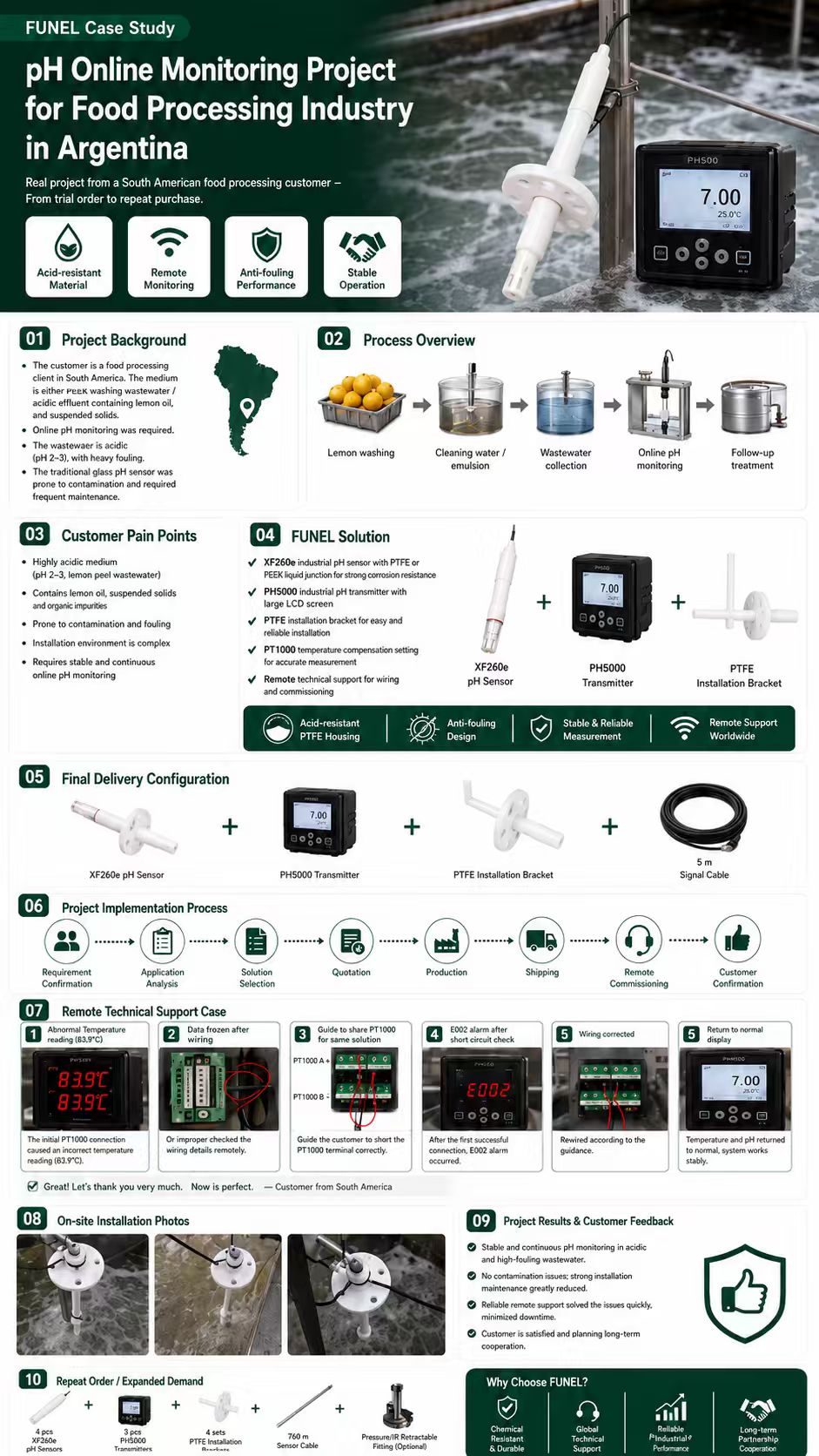
Argentina food-processing pH projectA real repeat-order project for acidic, high-fouling wastewater with remote support.↗Conductivity monitoring projectsPublished smart-water, wastewater, river and industrial monitoring records.↗ORP monitoring projectsReal wastewater and industrial rainwater monitoring installations.↗Questions to resolve before quotation.
What information matters most for an industrial water instrument quotation?+
Provide water chemistry, minimum, normal and peak values, continuous and cleaning temperature, pressure, flow, fouling, mounting, cable length, power, outputs, controller, quantity and destination.
Can a general-purpose pH sensor be used in every industrial process?+
No. Fluoride, low conductivity, high temperature, solvents, proteins, solids, reference poisoning and pressure may require a different electrode construction.
Can FUNEL instruments connect to a PLC or SCADA system?+
Many documented configurations support 4–20 mA and Modbus RS485. The exact sensor, transmitter, scaling, registers and panel responsibility must be confirmed in the quotation.