Water matrix and objective
State source water, plant intake, aquaculture, surface water, landscape water or seawater and the algal trend to be observed.
PCH-800A uses chlorophyll fluorescence for continuous chlorophyll-a measurement across 0–500 µg/L in source water, plant intake, aquaculture and surface water.
The supplied sheet notes that chlorophyll can be non-uniformly distributed and recommends multipoint monitoring. It also documents a water-turbidity condition below 50 NTU, so selection cannot rely on one concentration value.
State source water, plant intake, aquaculture, surface water, landscape water or seawater and the algal trend to be observed.
Provide minimum, normal and peak chlorophyll plus normal and upset turbidity.
Describe stratification, number of points, immersion location, pressure, mounting and maintenance access.
Confirm standard SUS316L or the titanium seawater version, cable, 4–20 mA, relays and RS485.
Configured with a black FUNEL single-parameter transmitter, SUS316L for standard water or optional titanium for seawater, with 4–20 mA and Modbus RS485.
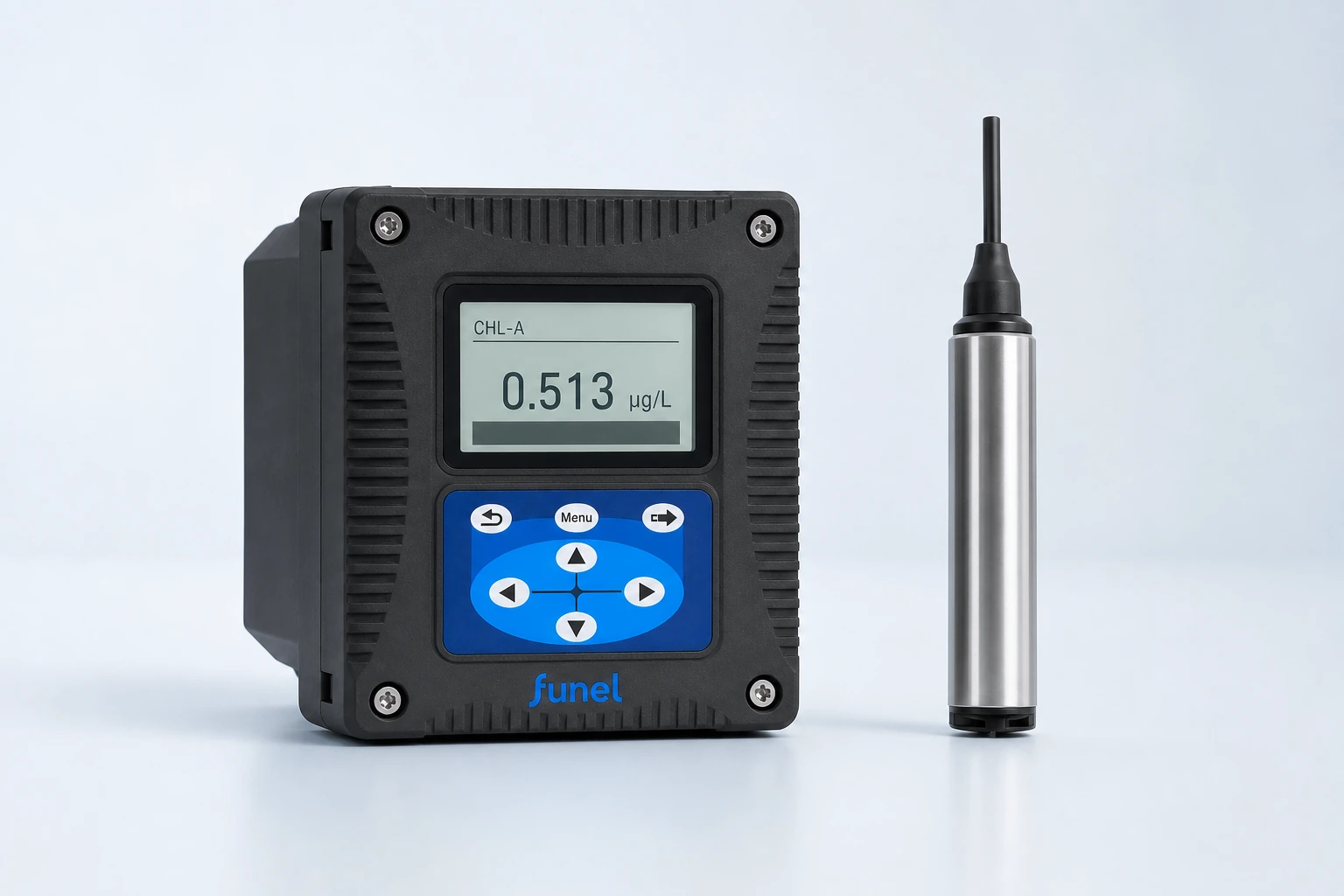 Fluorescence chlorophyll analyzer
A reagent-free fluorescence sensor for continuous chlorophyll-a measurement. Selection must consider spatial variation in algae and the documented turbidity condition below 50 NTU.
Before quotation, provide the monitoring objective, water matrix, expected chlorophyll range, normal and peak turbidity, number of monitoring points, pressure, material, mounting, cable, power, outputs and destination.
For source water, plant intake, aquaculture, surface water, landscape water and seawater. Use multiple monitoring points where the water body is stratified or non-uniform.
Track chlorophyll trends at raw-water sources and water-plant intakes.
Observe algal abundance in ponds, recirculating systems and aquaculture water.
Add continuous chlorophyll measurement to lakes, rivers and managed landscape water.
Use the documented titanium-alloy construction option when seawater compatibility is required.
Chlorophyll can be distributed unevenly in a water body, so one point may not represent the full site. The supplied sheet therefore recommends multipoint monitoring.
The documented condition is turbidity below 50 NTU. Higher-turbidity duty must be reviewed from the actual sample and process; the website does not promise suitability without confirmation.
The sheet lists a standard SUS316L version and a titanium-alloy seawater version. Selection should follow the actual water matrix.
No. It provides consistent public presentation. Sensor and transmitter dimensions remain controlled by the specifications and project confirmation.
We will respond with a recommended configuration, supporting documentation and quotation.