Industrial Wastewater Online Monitoring: A One-Enterprise-One-Pipeline Solution
A practical framework for industrial parks and factories to connect enterprise discharge lines to centralized treatment, trace abnormal loads and protect biological processes with continuous water-quality data.
1. Why industrial parks need source-level monitoring
A “one enterprise, one pipeline” model gives each enterprise a defined wastewater route into a shared treatment facility. In practice, operators often face four risks:
- Discharge attribution is difficult: manual sampling cannot continuously identify the source of an abnormal event.
- Water-quality shock loads: metals, solvents, high COD or other process chemicals can upset downstream treatment.
- Cross-contamination: damaged or poorly separated pipelines can mix wastewater between enterprises.
- Instrument durability: corrosive media and high ionic strength can shorten sensor service life.
2. Monitoring indicators and their operational value
| Indicator | Supervisory value | Process value |
|---|---|---|
| COD / ammonia | Supports discharge verification and environmental reporting. | Warns of increased organic or nitrogen loading before biological treatment is affected. |
| Heavy metals | Helps trace electroplating, metal-finishing and other regulated discharges. | Supports coagulant control and reduces the risk of sludge toxicity. |
| Pipeline pH change | Flags potentially non-compliant acidic or alkaline discharge. | Helps prevent pH shock and biological inhibition. |
| Conductivity / flow | Provides context for dilution, salinity and discharge volume. | Helps identify sudden process changes and normalize concentration data. |
3. Solution architecture
The monitoring system can be organized into three layers:
Field monitoring layer
Measure COD, ammonia, pH, conductivity and flow at enterprise outlets and key treatment nodes. Use suitable housings, bypass lines, cleaning access and alarm limits for the sample conditions.
View pH SensorData and evidence layer
Connect instruments to a platform that stores time-stamped measurements, calibration records, alarms and sample evidence. Access control should follow the project’s data-security requirements.
View MUC-200Response layer
When an abnormal trend is detected, trigger a defined response: retain a sample, notify the responsible team, review the process and document the corrective action.
Discuss a Solution4. Recommended FUNEL product direction
XF260E Industrial pH Sensor
For continuous pH monitoring at industrial discharge and treatment points. Confirm the required range, temperature, pressure, chemical compatibility and mounting before ordering.
View ProductPEC-500 Digital Conductivity Sensor
For conductivity context, salinity changes and process trend monitoring. Confirm the cell constant, range and wetted materials for the actual wastewater.
View ProductPUVCOD-900 UV COD Analyzer
For online organic-load trend monitoring where the sample matrix and required COD range are suitable. UV-based COD correlation requires application-specific calibration and is not automatically equivalent to a regulatory COD method. Request configuration review for fouling, cleaning and calibration.
View ProductPCM200 COD / NH3N analyzers
The source material shows COD and ammonia analyzer units. Contact FUNEL to confirm model availability and the required measurement method. UV organic-load monitoring does not replace ammonia analysis.
Request Model Confirmation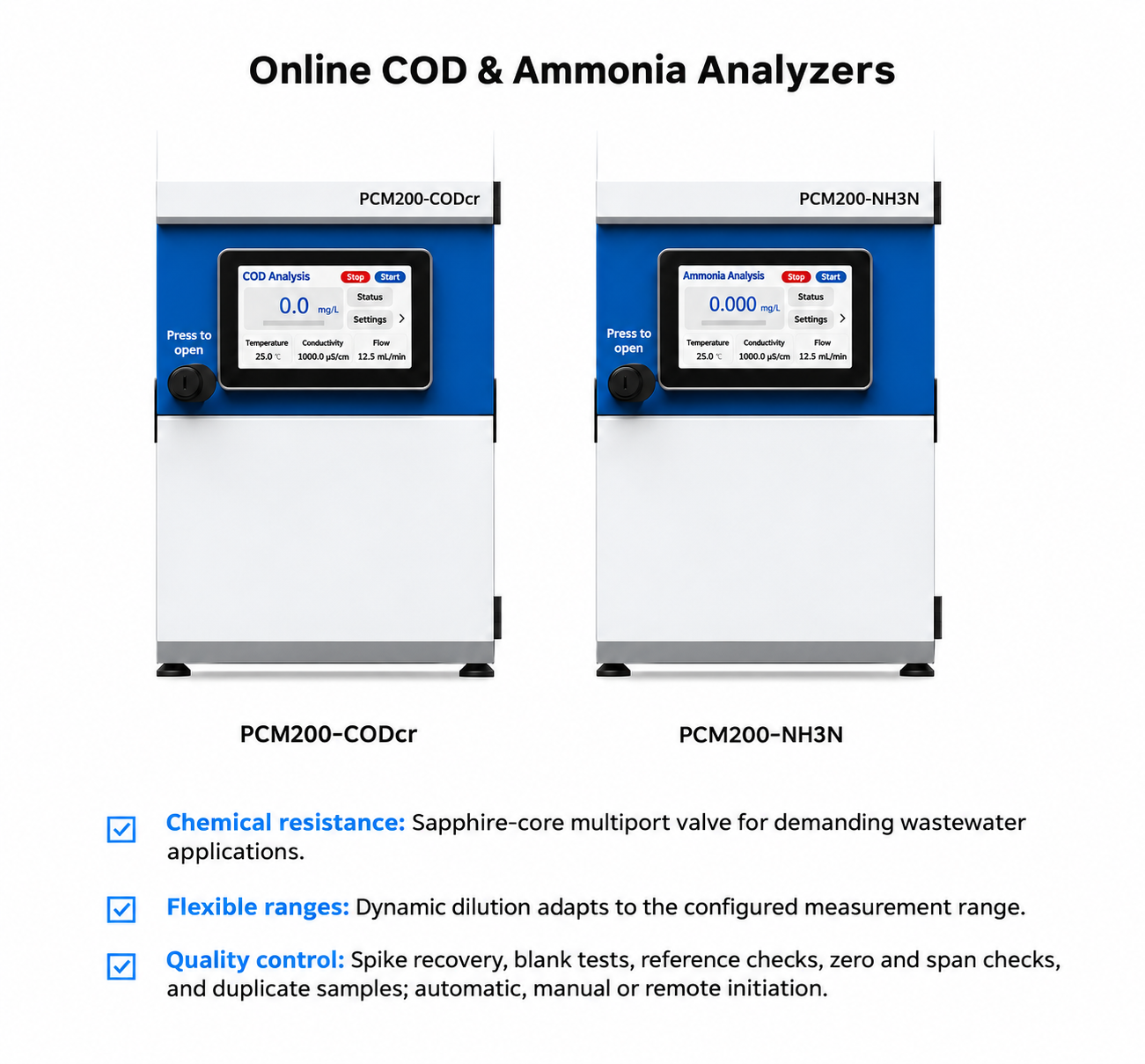
AI-edited product illustration. Confirm the model configuration and specifications for your application.
5. Platform and installation considerations
- Define monitoring points by enterprise outlet, shared pipeline, treatment inlet and discharge outlet.
- Choose sample conditioning, filtration, flow control and cleaning methods for the actual matrix.
- Set alarms from permits and process limits; do not copy generic thresholds across sites.
- Keep calibration, maintenance, access permissions and audit records with the measurement data.
- Use trend review to distinguish sensor fouling, sampling problems and real process events.
6. Application visual
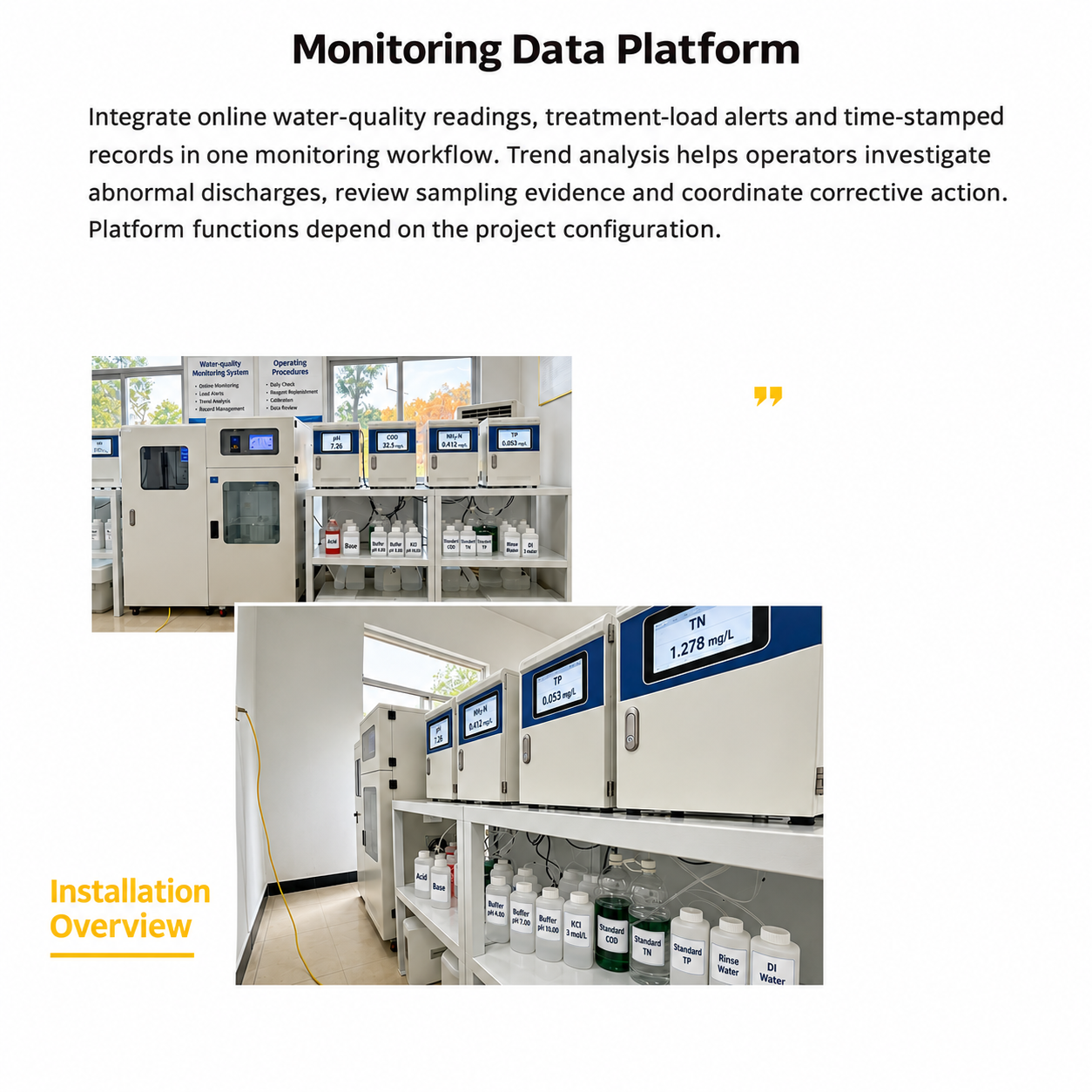
AI-edited English presentation image based on the supplied installation screenshot; screen readings and labels are illustrative, not site measurement records.
7. What to provide for a project quotation
- Wastewater source and industry process
- Target indicators and expected ranges
- pH, temperature, pressure, solids and fouling conditions
- Number and location of monitoring points
- Required outputs, communication protocol and platform integration
- Destination country, compliance requirements and installation timeline
Need an industrial wastewater monitoring configuration?
Send the water type, target indicators, ranges, installation points and communication requirements. FUNEL can review the measurement chain and suggest a suitable configuration.
Request a Solution